
Customer Experience (CX) Management
Designing The Customer Journey

Through critical analysis of touch points across the customer lifecycle, we can uncover pain points, unmet needs, and various internal and external friction points, followed by opportunities for improvement, innovation and operational change.
Customer journey mapping for current & future states including:
Customer life cycle stages
Touch points and pain points
Back and front stages
Persona creation
Target market segmentation
Opportunities for improvement
Alignment of KPI’s (CX metrics: NPS and OSAT) tied to business objectives
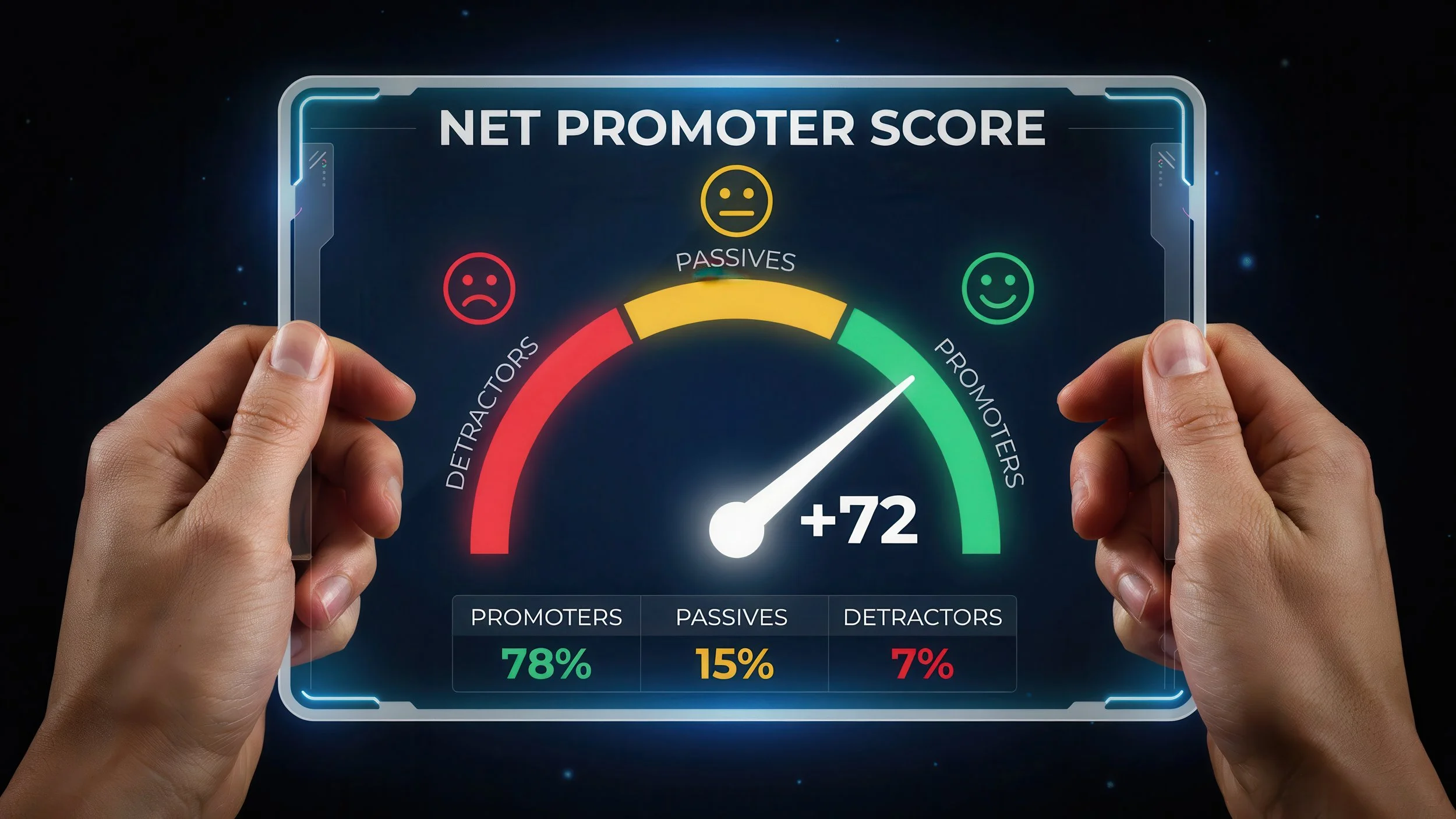
We use NPS to measure customer advocacy and combine it with Voice of the Customer (VoC) feedback to understand what customers are saying, why they feel the way they do, and where action can make the greatest difference.
Five ways NPS and VoC programs benefit your organization:
Understand what customers value
Identify issues early
Turn feedback into action
Strengthen loyalty
Make better customer-focused decisions with NPS and other CX metrics, creating benchmark indicator over time.
NPS tells you where customer loyalty stands. Customer feedback helps explain why. Cross-functional analysis determines what to change, and monitoring shows whether the change worked.
Voice of the Customer Programs and
NPS Studies
NPS gives leadership a consistent KPI for the customer relationship, rather than relying exclusively on multiple satisfaction questions that may be difficult to compare across products, locations, customer segments, or periods.
How organizations use it:
Establish a baseline NPS for evaluation over time.
Track changes following a product, service, or process improvement.
Compare NPS across customer segments, locations, channels, or business units.
Monitor trends over time rather than treating each survey as a standalone exercise.
VoC programs that include a complete NPS Study.
Transactional and/or relational surveys tailored to meet primary business objectives.
Social listening, online reviews, and market trends analysis
NPS and CSAT analysis
Text (verbatim) analysis
Customer advocacy strategic planning
Referral programs
Loyalty programs
Executive reporting and recommendations
Design Thinking Workshops Facilitation
Defining The “How Might We” CX Challenge

Framing the HMW (How Might We) statement to identify the main challenge.
Understanding feedback data with Empathy (uncovering customers’ deepest concerns)
Brainstorming, ideating, and capturing insights to solve real customer problems.
Cross-functional alignment.
Every workshop is immersive, practical, and rooted in real customer insights sourced by survey feedback data.
Bringing functional team members together to solve recurring challenges, using IDEO-Design Thinking methodology to boost creativity and uncover real customers’ concerns.
Through structured collaboration, based on IDEO Design Thinking methodology enhanced by Ai, an integral part of our services are workshops that facilitate the process of brainstorming and ideation, uncovering hidden needs and capturing meaningful insights. We help solve complex, recurring pain points, by prioritizing actionable insights, and unlock opportunities that drive loyalty, innovation, and long-term customer lifetime value.
Aligning Actionable Insights With Teams, Leaders and Stakeholders
Marketing: validates brand perception, campaign feedback, and improves messaging relevance, campaign effectiveness, brand positioning, and customer engagement.
Sales: understands buying motivations, objections, competitive feedback, and increases conversion rates and strengthens value propositions.
Customer Success and Support: analysis of customer interactions, recurring complaints, and satisfaction trends to identify prioritize escalation, and foster improvement opportunities.
Project Managers: Alignment initiatives meet customer expectations, reduce rework, and improve project outcomes.
Product Designers: translate customer feedback into product requirements, feature prioritization, and roadmap decision to drive product adoption.
Customer feedback often gets fragmented across Marketing, Customer Service, Operations, Product, Sales, and other functions. Trends, key drivers, and business risks need to be shared cross-functionally for full alignment and setting business priorities. The human-centric approach must be applied at all times.
Guiding leaders and teams from insight to execution—turning feedback into clear priorities is pivotal to sustainable transformation.
“Their attention to detail and commitment to quality truly stood out. We’ve already recommended them to others.”
– Former Customer